My AI agents over-checked a nine-page site. Now I set the check budget
In a review loop, agents answer findings with more checks and nobody prices them. Why the owner, not the agent, should set the verification budget, what I keep, and the rule I gave them.
Put AI coding agents in a review loop and they optimise for looking safe, not for shipping. A reviewer finds a gap, the author agent closes it with another test, gate or rollback path, and nobody asks what that check costs, because the agent does not pay for it. The owner does, in tokens, waiting and code that has to keep working. So the owner, not the agent, should set the verification budget. Mine is simple: checks stay where money, law, personal data and publishing are at stake, and everything else is a tax I approve line by line.
Who did what. I made the decision and approved every cut. Claude agents (Claude Opus 5.5 in Claude Code) audited the checks and made the cuts. The checks they removed had been written by Claude agents in the days before, many of them to answer findings from agent and Codex review rounds.
What happened
This site is a small static publication. When the agents audited it, they counted more than three lines of tests, gates and deploy tooling for every line of the site itself.
The loops that produced it were my own rule: I had asked for an adversarial review of every plan and every finished piece of work. One plan went through six review rounds in a single afternoon and got longer with every round. Its revision notes asked for “automatic rollback when served checks fail” and a rollback command with “its own journal kind with idempotent recovery”, for a site of static pages. We even had tests whose only job was to prove that other tests could fail.
So I told the agents, in Russian and less politely than this:
“Any extra tests, any migrations, rollbacks, all kinds of extra reviews. Everything goes directly through me. I forbid you to waste time on this stuff. This is just an information site for now.”
They deleted about 11,800 lines. The preview and production builds came out byte-identical to the builds before the cut, and the site went live the same day.
Why the checks pile up
Adding a check is the easy answer to a finding. A reviewer’s job is to find gaps. Closing one with a new check ends the discussion; arguing that the gap does not matter, or removing an old check, needs a reason. My process made the first easy and did not ask for the second.
Checks breed checks. Once a gate must be proven able to fail, the gate needs probes. Once deploys can roll back, the rollback needs tests. Each layer looks reasonable on its own.
Nobody priced them, me included. I never asked what a check cost or which loss it prevented. That question belongs to whoever pays, and the agent does not.
Where checks stay
The same rule, run on my tutoring site, cut much less, and that is the point. That site takes payments, keeps student accounts and publishes legal pages. About its checks I made one exception:
“That really is the place: law, money. Better to leave them there.”
In a change I merged the same day, the agents removed agent paperwork: a commit-trailer ritual, a module-boundary check with almost nothing left to guard, unused packages. No test file was deleted. They also cut a CI job that measured coverage over a list of files that had almost all been deleted months earlier. It looked like pure waste. The only file still on that list was the payment audit log, so the job went back. That is what a budget means in practice: judge a check by what it protects today, not by what it was written for.
What to keep, what to cut
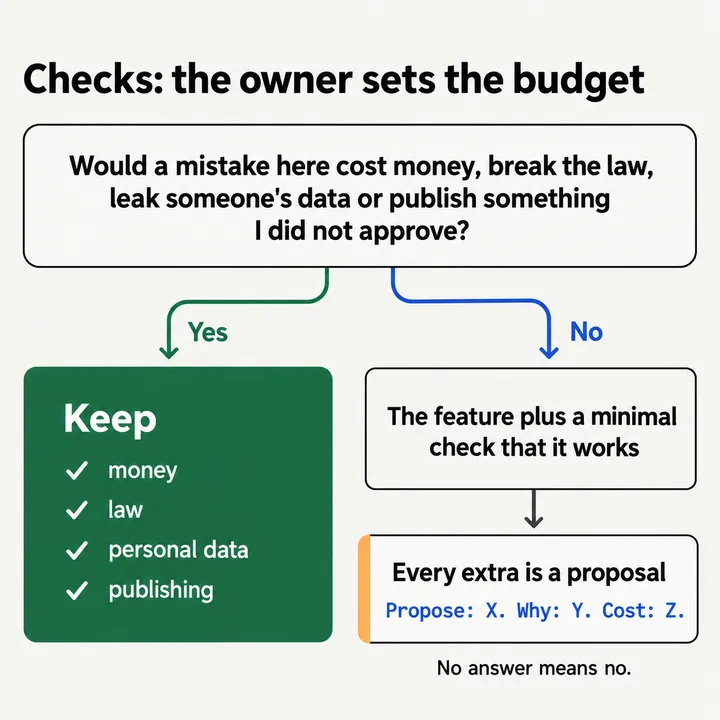
The question for every check: would a mistake here cost money, break the law, leak someone’s data or publish something I did not approve?
Keep:
- Anything on the money path: payments, payment records, the checks around them.
- Legal text and the rules that guard it.
- Personal data: accounts, consent, deletion.
- The approval of what gets published, and the guarantee that drafts never ship.
- Cheap basics your normal build already runs.
Cut, or turn into a proposal:
- Checks of checks, unless the check they prove guards money, law or data.
- Gates for features you do not have yet. Write the translation gate when the first translation ships.
- Rollback and recovery machinery that a plain redeploy replaces.
- Tests of machinery you are about to delete.
- Review rounds nobody asked for.
The rule I gave them
It lives in one file that both Claude Code and Codex read, and each project’s AGENTS.md points to it. Put yours wherever your agent reads instructions; CLAUDE.md and AGENTS.md: an annotated example shows which files each tool loads.
## Checks: the owner sets the budget

A plan holds the feature and the minimal proof it works:
the project's build, then open the page or run the command once.
Suites the build already runs may run. Nobody adds new ones.

Not done without my explicit yes:
- new tests, fixtures, harnesses or coverage floors
- probes that prove a check can fail
- new gates, linters, CI checks, hooks or commit trailers
- migrations and backfills, unless the feature cannot work without them
- rollback or recovery machinery
- review rounds I did not ask for
- documents the change does not need

To propose an extra, write one line and wait:
Propose: X. Why: Y. Cost: Z.
No answer means no. A yes covers that extra in that task only.

If an existing gate demands an extra, tell me before the work.
Do not satisfy it silently and never fake it.

Code that handles money, legal text or personal data keeps every
existing test, gate and required review. A cleanup never cuts it.
Ask your agent for the same audit
Before you cut anything, ask the agent what it would cut and why. This prompt only reads; paste it into Claude Code or Codex at the root of your project.
Audit the checks in this repository. Checks means tests, CI jobs, build gates, git hooks, deploy and rollback scripts, and review rules in the agent instruction files. Do not change or delete anything; only read.

For each check, say in one line what it protects today and what would break if it went away.
Mark it KEEP if a mistake there would cost money, break the law, leak someone's personal data or publish something the owner did not approve, or if the normal build already runs it cheaply.
Mark it CUT if it checks another check, guards a feature that does not exist yet, is machinery a plain redeploy would replace, or protects code that is no longer there.

Answer with a table: path, what it protects, lines, KEEP or CUT, one-line reason. Then the total lines you would cut, and a short list of the checks you are unsure about and why.
How we tried it. An agent procedure ran this prompt once on 2026-11-02, with Claude Code 2.1.312 and Claude Opus 5.5, on the snapshot of this site from before the cleanup. It changed nothing. It proposed cutting the same kinds of machinery the agents had removed: rollback paths that a plain redeploy replaces, translation gates for a site with no translations, checks of other checks. It kept the publishing approval and the privacy promises. It also listed what it was unsure about, such as whether a feature on the server was already installed. Read that list first, then decide yourself.
What I conclude
- The verification budget is the owner’s decision, like any other budget. The agent does not pay for checks, so it cannot price them.
- The default is the feature plus a minimal check that it works. Every extra is a proposal with a reason and a cost, and no answer means no.
- Where a mistake costs money, legal trouble, someone’s data or an unapproved page, checks are cheap insurance. Keep them even when they look heavy, and judge each one by what it protects now.
- An identical build shows that a cleanup did not change what readers get. It does not show what a removed check would have caught later. I accept that risk: a deleted check is still in the history, and if something breaks that it would have caught, it comes back.
This is one owner and two projects, and the cuts are new. I did not measure what the checks cost in time or tokens, so I make no claim about savings.