GPT-6.2 Astra and Sol reach Codex and Copilot, with a 4.5x faster Ultrafast mode
OpenAI's two new coding models are live in ChatGPT Work, Codex, the API and GitHub Copilot as of November 17. What each is for, who gets the Ultrafast speed option, and what the sources leave open.
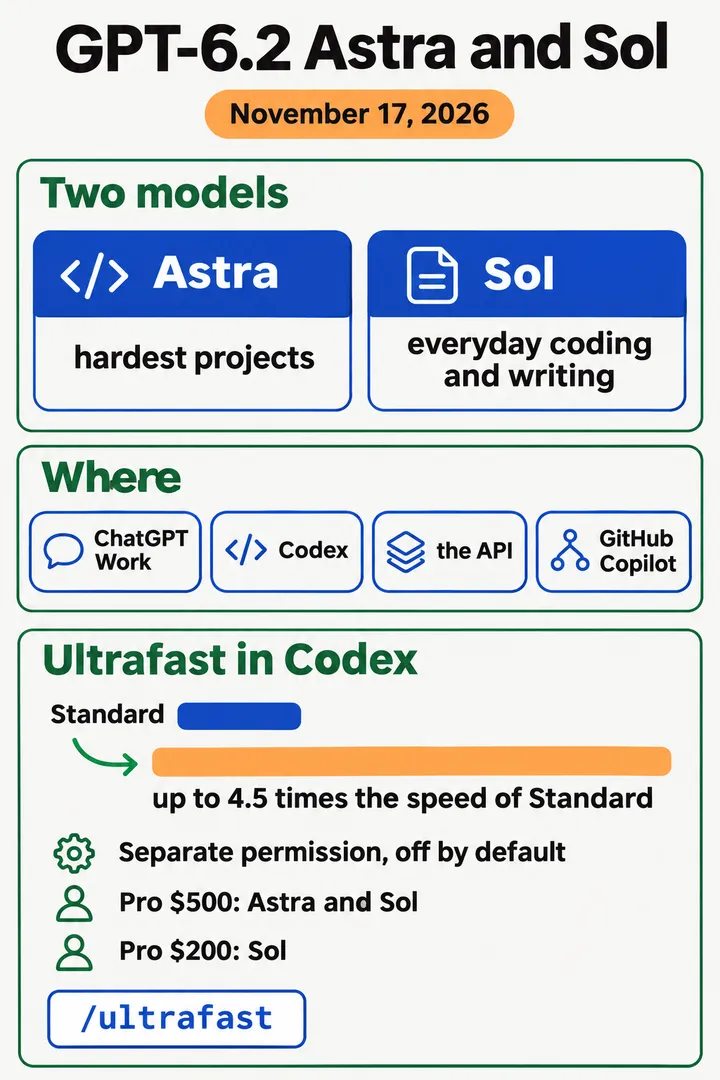
On November 17, 2026, OpenAI made GPT-6.2 Astra and GPT-6.2 Sol available in ChatGPT Work, Codex and the API, and GitHub made both generally available in GitHub Copilot the same day. Codex gains a speed tier called Ultrafast for these models, which OpenAI says generates tokens “at up to 4.5 times the speed of Standard on the same model”.
The facts
- Which model for what (OpenAI): “Choose Astra for your hardest projects or Sol for everyday coding and writing.” OpenAI adds that Sol “handles everyday coding, writing, and work that takes several steps” and that, compared with GPT-6.1 Sol, “it lets you complete more tasks on the same paid plan”.
- Ultrafast: available on GPT-6.2 Astra and GPT-6.2 Sol. On the Pro $500 plan both models can use it; on the Pro $200 plan the changelog lists Sol only. Enterprise workspaces need a credit-based or USD usage-based agreement, and Edu workspaces need a credit-based plan.
- Switching it on: a workspace owner must first enable the GPT-6.2 models,
and Ultrafast is a separate permission that is off by default. In the Codex
CLI the command is
/ultrafast; repeating it returns you to Standard. - Cost: OpenAI says Fast and Ultrafast both “use more of your plan’s allowance or credits”. On Pro $500, Ultrafast uses the included allowance first, then any available credits. Signed in to Codex with an API key, you pay API token rates and the ChatGPT credit multipliers do not apply.
- GitHub Copilot: both models are in the model picker on VS Code, Visual Studio, Copilot CLI, the coding agent, github.com, GitHub Mobile, the GitHub Copilot app, JetBrains IDEs, Xcode and Eclipse, for Copilot Pro+, Max, Business and Enterprise. Rollout is gradual. Business and Enterprise admins control access in the Copilot model policy; unless an admin has turned off the global default for new models or disabled these two, they are enabled automatically.
- GitHub’s early testing: GitHub says Astra caught significantly more issues in code review than GPT-6 Astra and finished agentic coding tasks with noticeably fewer tokens, and that Sol caught nearly twice as many real issues in code review as GPT-6.1 Sol. These are GitHub’s statements about early testing, not our measurements.
What it means for builders
Analysis: if your team shares a Codex or ChatGPT Work workspace, the switch that matters is administrative. The new models do nothing until an owner enables them, and Ultrafast needs a second grant on top, so a developer who cannot see the option should ask the owner before assuming a plan problem. In Copilot the opposite default applies: unless an admin turned off new-model defaults, the models appear automatically on Business and Enterprise, so check the model policy if you pin approved models for compliance.
Ultrafast trades allowance for latency. If you run long agent sessions near a plan limit, keep Standard as the default and use the faster tier for interactive work. The “more tasks on the same plan” claim for Sol is OpenAI’s own and gives no figure, so measure it on your workload before changing a budget.
Not stated in the sources
Model IDs and API prices for GPT-6.2 Astra and Sol, usage limits per plan, and the Copilot price for these models: GitHub says only that they are billed at provider list pricing under usage-based billing. OpenAI’s main announcement page returned an access error to us, so this item rests on OpenAI’s Codex documentation and on GitHub’s changelog.