Cursor's Agent SDK is generally available
Cursor now lets you define an agent as a folder, test it with evals and deploy it to Cursor or your own infrastructure, triggered from GitHub, Slack, webhooks or a schedule.
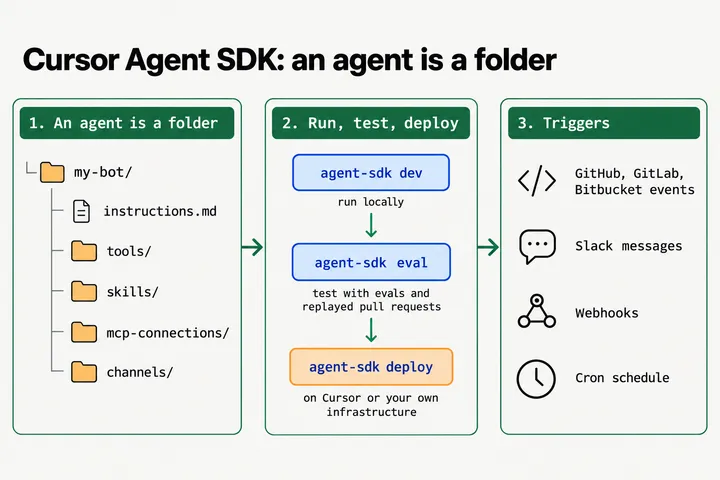
Cursor announced on October 20, 2026 that its Agent SDK is generally available. It lets you “define an agent as a folder of code, test it with evals, and deploy it to Cursor or your own infrastructure”, in the changelog’s words. Agents can react to GitHub, GitLab and Bitbucket events, Slack messages, webhooks or a cron schedule.
The facts
- Project layout:
instructions.mdfor the prompt, plustools/,skills/,mcp-connections/andchannels/folders. - Getting started:
npx @cursor/agent-sdk init ./my-bot, thenagent-sdk devto run it locally andagent-sdk deploy, which builds the agent, gives it a URL and starts it on Cursor’s infrastructure. - Testing:
agent-sdk evalruns evals, andagent-sdk github replay <pr-url>replays a real pull request, with--dry-runand a fixtures directory. - Templates: a security reviewer, an owners-policy approver, a pull request autofixer and a Linear or Jira triager.
- GitHub events: they arrive through your Cursor account, so no public webhook URL is required.
What it means for builders
Analysis: the same idea as GitHub Agentic Workflows, packaged differently. An
agent becomes a folder you can version, test against replayed pull requests
and deploy, rather than a prompt pasted into a chat. The skills/ folder
suggests reuse of skills you already have, but the changelog does not say
which skill format it expects, so check the documentation before you rely on
it.
Not stated in the announcement
Pricing, plans, regions, runtime or usage limits, and the supported Node or SDK language versions.